

By late July the valley sky often turns beige an hour before a storm arrives, and most residents file the change under weather rather than health. For people with sensitive airways, the same hour registers as something far more specific. A cough starts once the wind picks up, chest tightness interrupts an evening walk, or a morning of shortness of breath appears that was not there the day before and fades once the air settles. Those experiences are common enough here that many residents stop mentioning them, which is precisely how a pattern worth evaluating goes unreported for a season.
Las Vegas dust air quality deserves a more careful reading than the single number most people check. The pollutant mix over the valley changes by hour and by month, and the same index value can mean coarse soil dust on one afternoon and heat-driven ozone on the next. This guide covers what those pollutants may do inside an airway, which respiratory symptoms generally pass on their own, and the point at which persistent breathing changes are worth an appointment with a primary care physician. None of it substitutes for an evaluation by a provider who knows your history.
Knowing the Air Quality Number Does Not Tell You What Your Lungs Will Do
Live air-quality applications answer one question well, which is how poor the air is at this moment. They say very little about how a particular airway will respond, and that gap explains why two people standing in the same parking lot have completely different afternoons. Someone with no airway history may notice nothing beyond gritty eyes, while someone managing asthma finds a walk to the car harder than it was last week. The air quality index blends several pollutants into one figure, which means two days with identical readings may affect you differently depending on which pollutant drove the number.
The more useful question for most patients is not how high the number climbed but how their own symptoms behaved afterward. Irritation that begins during a wind event, stays mild, eases indoors, and clears within a day or two follows the pattern most valley residents describe. Symptoms that outlast the weather, appear at rest, wake you at night, or arrive with a fever are describing something other than a passing exposure. That distinction, rather than any reading on a phone, is what a physician works from.
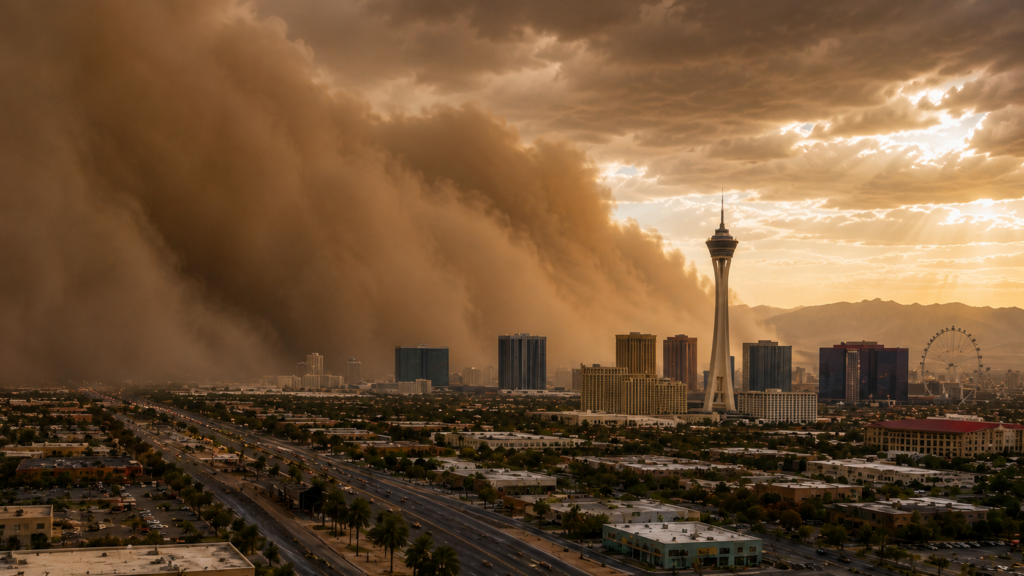
The Particles Monsoon Season Lifts Into Valley Air
Southern Nevada’s monsoon pattern generally runs from early July into September, and the outflow winds ahead of thunderstorms can move loose material off open desert ground within minutes. That material becomes coarse particulate matter, measured as PM10 because the particles are 10 micrometers or smaller in diameter. Disturbed desert soil contributes most of it, while construction dust, unpaved lots, and vacant graded parcels around the valley’s growing edges add more.
Clark County’s air agency operates monitoring stations across the basin and issues dust advisories when conditions warrant, and the national 24-hour standard for PM10 is 150 micrograms per cubic meter, a level blowing dust events in the valley can approach or exceed. That county monitoring network is the source of the figures your weather app reports, and the advisories it issues are the local signal worth acting on rather than a national average.
Soil is not the only source, and the others follow different schedules. Fine particulate matter, or PM2.5, comes from combustion rather than ground disturbance, so vehicle exhaust along the resort corridor and the interstates produces it year-round. Wildfire smoke drifting in from California and the Pacific Northwest can raise valley levels for days at a stretch during late summer, entirely independent of local wind. Heat contributes a third pollutant, since on days when temperatures climb past 100 degrees, sunlight reacts with vehicle and industrial emissions to form ground-level ozone, which the EPA describes as a lung irritant even at concentrations producing no visible haze.
Why Timing Often Points to the Responsible Pollutant
The hour at which symptoms appear frequently identifies which exposure is involved. Dust-driven irritation tends to begin during or immediately after the wind, tracking the visible event closely enough that most people make the connection themselves. Ozone exposure behaves differently, often peaking in the afternoon and early evening after hours of heat and sunlight have driven the reaction. Someone who feels fine during a dust storm and short of breath at six in the evening may be responding to ozone rather than the dust everyone noticed.
That timing detail is worth recording, because it is information a physician cannot reconstruct later. A brief note of when symptoms started, what the weather was doing, and how long the episode lasted turns a vague complaint into a usable history. Patients who bring that record tend to get further in a single visit than patients who describe a general bad month. Two or three dated entries are enough, and a note on a phone works as well as anything more formal.
What Happens Inside the Airway During a Dust Advisory
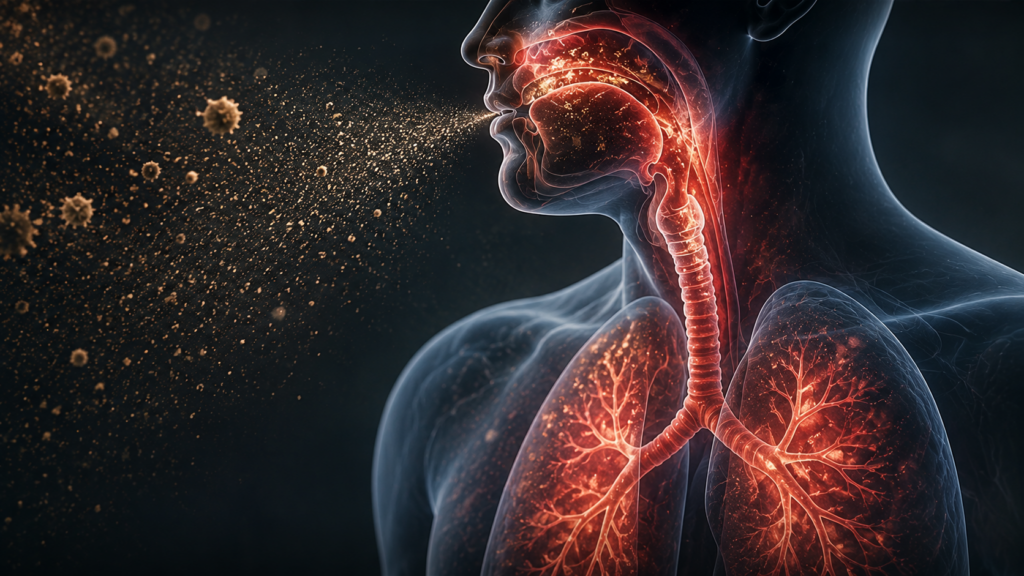
Particle size determines how far into the lungs an inhaled particle travels, and that single fact explains much of what people feel during a dust event. PM10 particles are large enough that the nose, throat, and larger bronchial tubes trap most of them, according to the EPA. Those tissues respond as they would to any irritant, producing a scratchy throat, airway irritation, increased mucus production, and a persistent cough that clears what has settled there. The discomfort is real, though the mechanism is mechanical irritation rather than infection.
Smaller particles behave differently and reach further. PM2.5 particles can travel to the small airways and the alveoli, the air sacs where oxygen crosses into the bloodstream, and because they reach that depth they can cross into the bloodstream and provoke inflammation beyond the lungs. That systemic reach is the reason PM2.5 is studied in relation to heart disease and stroke rather than lung disease alone. This is why fine particles from smoke or traffic warrant attention even on days when nothing looks dusty. Visibility is a poor guide to what is actually reaching the deepest part of the lung.
Airways That Already Carry Inflammation React More
In asthma, the muscle layer wrapping the bronchial tubes may tighten in response to an inhaled irritant, narrowing the passage and producing wheezing, cough, or the sensation that a full breath will not complete. The CDC lists particulate pollution among the environmental triggers that may contribute to asthma symptoms. That does not mean a dusty afternoon causes asthma, and the distinction matters. It means an airway already primed to react simply has more to react to, which is why the same air produces different results in different people.
Chronic obstructive pulmonary disease, or COPD, narrows and damages the airways over time, and many people managing it report that particulate days feel harder than the calendar suggests they should. The same holds for chronic bronchitis and for asthma at any level of control. A COPD flare triggered by an environmental exposure may look like increased cough, thicker sputum, or breathlessness during activity that felt routine last week. Sorting that pattern out belongs with your physician, and a companion guide covers managing asthma and COPD through the valley’s dust season in more detail.
Residents Who Tend to Notice Dust Exposure First
Cardiovascular disease belongs in this conversation, which surprises many patients who assume air quality is purely a lung question. The American Heart Association has published scientific statements concluding that fine particulate exposure is a modifiable contributor to cardiovascular morbidity and mortality, with both short-term exposure and long-term exposure implicated. Someone managing heart failure, coronary artery disease, or an arrhythmia may therefore be advised to watch air quality as closely as someone managing a lung condition. If you are already under care for a cardiac condition, your care team is the right source for what applies to your situation. General guidance cannot account for an individual cardiac history.
Age shifts the picture in both directions, since older adults may have less pulmonary reserve to absorb an irritant exposure and children breathe more air relative to body weight than adults do. Outdoor workers in construction, landscaping, and utilities accumulate hours of exposure that a resident moving between air-conditioned buildings never encounters. People with seasonal allergies often have the hardest time separating causes, because fall pollen and monsoon dust overlap on the calendar and produce a similar set of complaints. A physician who manages more than one condition at a time is well positioned to untangle which trigger is doing what, and a related piece covers what may be driving fall allergy symptoms here.
Expected Irritation Compared With Symptoms Worth an Appointment
Most dust storm respiratory symptoms follow a pattern that tracks the weather closely. They begin during or shortly after the event, remain mild, ease when you go indoors, and fade within a day or two once air quality improves. Nasal congestion, a scratchy throat, watery eyes, and a dry cough are the reactions valley residents describe most often, and they rarely call for more than time and reduced exposure. Recognizing that ordinary pattern is what makes the exceptions easier to spot.
Several patterns deserve a closer look rather than another week of waiting. A cough that persists beyond two to three weeks has outlasted what a single dust event explains, and your physician may want to evaluate it. New wheezing in someone with no history of it, breathlessness during activity that was comfortable a month ago, shortness of breath at rest, and repeated nighttime coughing that interrupts sleep are all reasons to schedule rather than wait for the next clear-air week. So is any cough bringing up blood, or a fever accompanying breathing changes, since those point toward causes unrelated to particulate exposure. Blue Point’s guide to symptoms worth raising in primary care covers this territory further, alongside a companion piece on the smaller changes doctors track during checkups.
Severe difficulty breathing, chest pain, blue-tinged lips, or confusion call for emergency care rather than an office appointment. Those signs are uncommon, and naming them is not a prediction about your symptoms. It is the same line any physician would draw in the room, stated plainly so that nobody spends an evening deliberating over whether to wait until morning. Emergency evaluation exists for exactly these situations, and using it is not an overreaction.
What a Primary Care Evaluation for Breathing Changes Involves
An evaluation generally opens with history rather than equipment. Your physician may ask when symptoms started, whether they track outdoor exposure or dust advisories, what your work environment involves, whether anyone in your household has similar complaints, and what your health history and risk factors already include. That conversation shapes everything that follows and often narrows the possibilities before a single test runs. The physical exam typically includes listening to the lungs across several positions and checking oxygen saturation with a fingertip pulse oximetry reader.
From there, pulmonary function testing measures how much air you move and how quickly, which allows a physician to distinguish an obstructive pattern from a restrictive one. Spirometry, the most common of these breathing tests, records the volume and speed of a forced exhalation and takes a few minutes in the office.
Breathlessness does not always originate in the lungs, and an evaluation accounts for that. When the history suggests a cardiac contribution, your physician may order an electrocardiogram to assess heart rhythm, and blood work may screen for anemia, thyroid dysfunction, or inflammation that a breathing complaint alone would not reveal. Blue Point’s on-site specimen collection keeps that step in the same building, and a separate guide explains how lab testing connects symptoms with underlying concerns. Some patients need chest imaging or a pulmonology referral, which your primary care physician coordinates rather than leaving you to arrange.
Reducing Exposure on High-Particulate Days and What It Cannot Do
Checking the daily AQI forecast before outdoor activity costs nothing and changes the exposure math meaningfully. Many valley residents shift runs and yard work to early morning, when winds are calmer and ozone levels have not yet built through the day’s heat. Setting a vehicle’s ventilation to recirculate during a dust event keeps outside air from cycling through the cabin, and closing windows during high-wind hours accomplishes the same at home. A HEPA filter in a portable purifier, or a higher-rated filter in a central system, may reduce indoor particulate levels, though no filter substitutes for medical care when symptoms persist.
Outdoor workers face a different calculation, since staying inside is not available to them. NIOSH-approved N95 respirators filter fine particles when they fit correctly, and where an employer requires respirator use, federal occupational safety rules require a full respiratory protection program around it: written procedures, medical evaluation before use, and fit testing. A respirator handed out without those steps is not the same protection. Fit matters as much as the rating, and a respirator worn loosely provides considerably less protection than its label suggests. Workers with an existing airway condition may want to review their situation with a physician rather than rely on a general workplace policy.
Anyone with a prescribed rescue inhaler or a written asthma action plan should follow the plan their own physician wrote, and reaching for that inhaler more often than usual is itself worth reporting. Increased rescue use is one of the more reliable early signals that a plan needs revisiting, and it frequently goes unmentioned because patients treat it as a seasonal inconvenience. Blue Point’s primary care team can review a plan that no longer matches your symptoms, and patients managing chronic respiratory conditions benefit from regular lab monitoring as part of ongoing care. A plan written two seasons ago may not reflect what your airway is doing now.

Frequently Asked Questions
Are Air Purifiers Worth Running During Dust Season?
A portable air purifier with a true HEPA filter may lower fine particle counts in the room where it runs, and upgrading a central HVAC filter may reduce levels across a whole home. Neither addresses ozone, which behaves differently from particles and is not filtered the same way. Purifiers reduce exposure rather than treat symptoms, so a lingering cough that continues while one is running still deserves evaluation.
Can I Tell Allergy Symptoms and Dust Irritation Apart at Home?
Both may produce sneezing, congestion, and cough, which makes self-sorting genuinely difficult. Allergy symptoms more often involve itching of the eyes, nose, and throat, while dust irritation tends to track wind events closely. Allergy testing and a symptom history reviewed with your provider give a clearer answer than guesswork, and either pattern may coexist with fall pollen.
Why Do I Feel Worse in the Evening Than During the Storm?
Ground-level ozone forms when sunlight reacts with vehicle and industrial emissions, and levels often peak in the afternoon and early evening rather than during a wind event. Someone reacting to ozone may feel fine while the dust is visible and short of breath hours later. Noting the time your symptoms appear gives your physician a useful clue about which exposure is involved.
Conclusion
Las Vegas dust, fine particles, and summer ozone may affect breathing differently from one person to another. While mild irritation often improves once air quality improves, symptoms such as a persistent cough, new wheezing, repeated nighttime coughing, or shortness of breath that continues after the weather changes may be worth discussing with a physician. Breathing changes can have several possible causes, so an evaluation based on your symptoms, medical history, and appropriate testing can help clarify what may be contributing.
Blue Point Medical Group’s board-certified physicians can evaluate ongoing respiratory symptoms and determine whether testing such as lung function studies or other diagnostic services may be appropriate. If your breathing symptoms have lasted longer than expected or are beginning to interfere with your daily activities, Contact Blue Point Medical Group to schedule an appointment with a licensed provider.