

Men do get osteoporosis, although it is less common than in women. Using National Health and Nutrition Examination Survey data from 2017 to 2018, the US Preventive Services Task Force reports an age-adjusted prevalence among US adults aged 50 and older of 19.6% in women and 4.4% in men.
The same January 2025 statement notes that although fragility fractures are more common in women, excess mortality related to osteoporosis and fragility fractures is greater in men. The challenge is that osteoporosis screening in men is far less standardized than it is for women. There is no single preventive screening age accepted across major US organizations, which means risk factors and clinical judgment often determine when a bone density test should be considered.
Osteoporosis in men is less common, and more dangerous once a bone breaks
Blue Point’s guide to the preventive tests recommended for women reflects one important difference: the US Preventive Services Task Force recommends bone density screening beginning at age 65 for women.
For men, the evidence is less certain. The Task Force does not establish a routine screening age because the screening trials it reviewed did not include men.
The consequences of osteoporosis can still be serious. A 2026 review in JAMA reports one-year mortality after hip fracture in the United States between 2008 and 2017 of 26.9% among men and 18.5% among women.
An older Danish national register study followed more than 41,000 patients with hip fractures and found 12-month cumulative mortality of 37.1% in men compared with 26.4% in women. Even after adjustment for age, fracture site, medication use, and other medical conditions, men had a higher mortality risk.
Research has also documented a large difference in how often DXA testing is ordered for men and women. A US primary care analysis covering visits from 2012 through 2019 found that dual-energy x-ray absorptiometry (DXA or DEXA)was ordered far less often for eligible men than for eligible women.
That finding does not show how many men eventually received a scan, but it highlights the broader screening gap.

The risk factors that decide whether a man is a candidate at all
Because there is no universally accepted age for routine osteoporosis screening in men, risk factors become especially important.
A systematic review and meta-analysis identified several factors associated with osteoporosis in men, including:
Older age, low body mass index, current smoking, excessive alcohol use, long-term corticosteroid use, previous fracture, falls, hypogonadism, stroke, and diabetes.
Among these, chronic corticosteroid use is one of the clearest clinical triggers for considering bone health.
Medicare regulations, the Bone Health & Osteoporosis Foundation, and the International Society for Clinical Densitometry all identify long-term oral glucocorticoid use as an important risk factor. A commonly cited threshold is treatment equivalent to 5 mg of prednisone or more per day for longer than three months.
These thresholds refer specifically to oral glucocorticoids. They do not establish the same dose-and-duration rule for inhaled corticosteroids.
Androgen deprivation therapy and low testosterone
Androgen deprivation therapy for prostate cancer is another important risk factor.
A 2021 meta-analysis involving more than 500,000 men found an increased fracture risk among men receiving androgen deprivation therapy. The Bone Health & Osteoporosis Foundation includes this treatment among the reasons a man may need bone density evaluation.
Hypogonadism, or low testosterone, is also associated with bone loss. A low testosterone result by itself does not automatically establish osteoporosis, but it can become part of the risk profile a physician considers when deciding whether a bone density test would be useful.
Smoking, alcohol, and other secondary causes
Smoking and heavy alcohol intake are also associated with lower bone health.
The Bone Health & Osteoporosis Foundation notes that moderate alcohol consumption has not been shown to have the same adverse effect, while more than three alcoholic drinks per day for men may be detrimental to bone health.
Other medical conditions can contribute to secondary osteoporosis as well, including untreated thyroid disease and certain chronic illnesses.
No single risk factor always determines whether a scan is needed. The decision depends on the combination of age, medical history, medications, previous fractures, and whether the result would change treatment.
No age sets the line for men, and the guidance does not completely agree
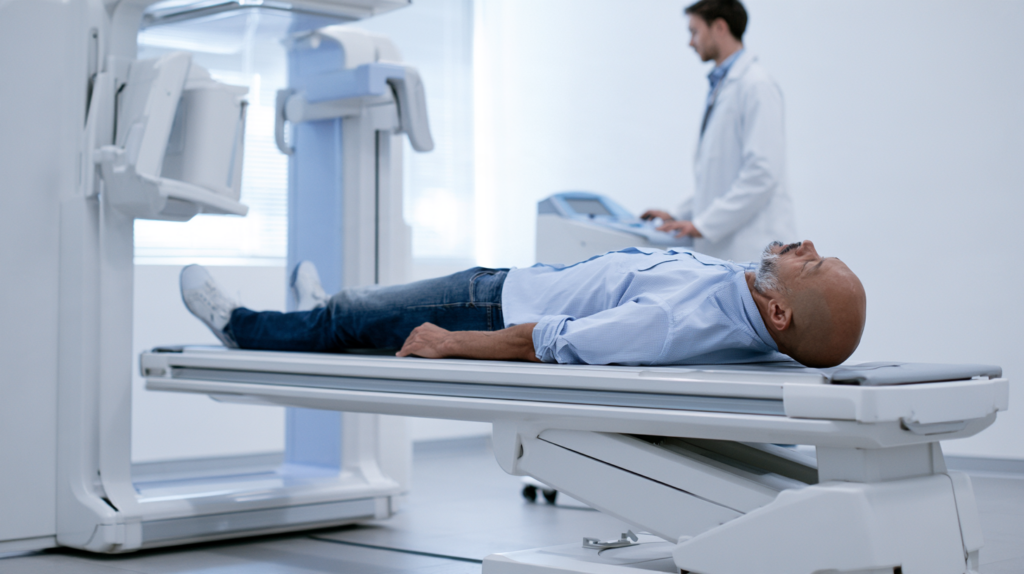
Several professional organizations recommend bone density testing for men beginning at age 70.
The International Society for Clinical Densitometry recommends bone mineral density testing for men aged 70 and older, as well as for younger men with risk factors.
The Bone Health & Osteoporosis Foundation’s 2022 clinician’s guide follows a similar approach, recommending testing at age 70 regardless of risk factors and for men ages 50 through 69 when their risk profile supports it.
However, the US Preventive Services Task Force does not set a routine age for men.
Its January 2025 recommendation concludes that the evidence is insufficient to determine the balance of benefits and harms of routine osteoporosis screening in men. This is a Grade I statement, meaning the evidence is insufficient, not that screening is discouraged.
The Task Force specifically clarified that an I statement should not be interpreted as a recommendation against screening. Instead, clinicians and patients are expected to decide together when screening may be appropriate.
That distinction matters. A man may still reasonably undergo a DEXA scan based on age, fracture history, medications, or other risk factors even though the Task Force has not established a universal screening age.
Medicare pays for a bone density scan, but not because a man turned 65
Medicare Part B covers certain bone mass measurements, but eligibility does not automatically begin when a man reaches age 65.
The Medicare coverage page states that qualifying bone mass measurements may be covered once every 24 months when medical criteria are met.
The regulation behind that coverage identifies several clinical categories rather than a general age-based rule for men.
Two routes particularly relevant to men include long-term oral glucocorticoid treatment and certain vertebral abnormalities identified on X-ray.
That means a man can meet recommendations from a professional organization to consider a DXA scan while still needing a separate qualifying medical indication for Medicare coverage.
Coverage also depends on medical necessity and documentation, so the clinical recommendation and the insurance determination are related but not identical questions.
Raising bone health at a primary care visit
Because routine osteoporosis screening guidance for men is less standardized, the conversation often begins with a careful review of personal risk factors and medical history. Important details include long-term oral steroid use, particularly the dose and duration, current or previous androgen deprivation therapy for prostate cancer, and any fracture after age 50 caused by a relatively minor fall or injury. A history of low testosterone, recent falls, smoking, low body weight, and other medical conditions associated with bone loss can also help a physician assess whether additional evaluation is appropriate.
Rather than simply asking whether you need a bone density test, discussing these specific risk factors gives your physician more useful information for estimating your overall fracture risk. The Bone Health & Osteoporosis Foundation emphasizes that bone density testing is most valuable when the result could influence treatment, prevention, or other management decisions. A physician can consider your age, medications, fracture history, and overall health before deciding whether a DEXA scan would provide information that could meaningfully change your care plan.

Frequently Asked Questions
How are bone density results interpreted in men under age 50?
In men younger than 50, bone mineral density results are interpreted differently than they are in older adults. The International Society for Clinical Densitometry recommends using Z-scores rather than T-scores in this age group, because bone density alone is not enough to diagnose osteoporosis before age 50. A scan can still provide useful information when significant risk factors are present.
Beginning at age 50, T-scores become more relevant when evaluating bone density. A T-score of -2.5 or lower at certain skeletal sites can meet the bone-density definition of osteoporosis. Even so, the result should be interpreted alongside fracture history, medications, medical conditions, and other factors that may affect overall fracture risk.
Do inhaled steroids for asthma or COPD carry the same osteoporosis risk as oral prednisone?
The specific osteoporosis thresholds used in the guidance discussed here apply to oral glucocorticoids, such as prednisone, rather than inhaled corticosteroids. Long-term oral steroid use at certain doses is a recognized risk factor for bone loss and can influence whether a physician recommends bone density testing.
That does not mean inhaled corticosteroids have no relationship to bone health. Their effect depends on factors such as dose, duration, age, other medications, and the patient’s overall risk profile. Patients using inhaled treatments for asthma or COPD should not stop or change them because of bone concerns without first discussing those concerns with their physician.
Can I ask for a bone density scan even if my doctor has not suggested one?
Yes. Because there is no universally accepted screening age for osteoporosis in men, it is reasonable to ask whether your personal risk factors make a bone density test appropriate. A history of fractures, long-term steroid use, low testosterone, smoking, low body weight, falls, or other medical conditions may make that conversation particularly relevant.
Your physician can review those factors and determine whether a DEXA scan is likely to provide information that could affect treatment or prevention decisions. Insurance coverage is a separate question, so Medicare or another insurer may still require specific medical criteria or documentation before covering the scan.
Conclusion
Osteoporosis in men is less common than in women, but the consequences of a fracture can still be serious, especially later in life. Because there is no single screening age accepted across every major US medical organization, decisions about testing often depend on a man’s individual risk factors rather than on age alone. Long-term steroid use, prior fractures, low testosterone, androgen deprivation therapy, smoking, falls, and low body weight can all influence that decision.
A primary care visit is an appropriate place to review those risks and decide whether bone density testing could meaningfully change your care plan. If you are concerned about osteoporosis or have risk factors for bone loss, contact Blue Point Medical Group to schedule an appointment. Our primary care team can review your medications, fracture history, medical conditions, and other factors to help determine whether a DEXA scan or additional evaluation may be appropriate.