

Search for guidance on high blood pressure and you find a page about blood pressure. Search for type 2 diabetes and you find a page about diabetes. Medical charts rarely read that cleanly, and adults past fifty frequently carry two or three diagnoses simultaneously. The way those conditions interact often shapes care more than any single one of them does on its own, which is precisely the layer that single-condition content leaves out.
Your physician treats multiple chronic conditions as one interacting system, and that work sits at the center of internal medicine. One condition may change the treatment target for another, narrow which medications remain safe, or soften a warning sign that would stand out if it appeared alone. Most older American adults live with more than one chronic condition.
CDC analyses have put the share of adults 65 and older with two or more concurrent chronic conditions at roughly two-thirds, rising further past age 75, so this situation is the norm rather than the exception. What follows covers how comorbid conditions influence one another, why coordinating chronic disease care under one physician may produce a different plan than three specialists working in parallel, and what a coordinated visit tends to include.
Single-Condition Advice Falls Apart Against a Real Medication List
Most patient education is written one diagnosis at a time, a structure that serves a reader with one condition and collapses for someone with four. A person managing diabetes, hypertension, and high cholesterol encounters three sets of dietary guidance, three monitoring schedules, and three lists of warning signs, with nothing explaining which instruction takes precedence when two of them disagree. The result is not merely confusion. It is a patient making that call alone, usually by guessing, which is the opposite of what any of those pages intended.
Physicians run into the same problem from the other direction. Clinical guidelines are written per disease, and following each one to the letter can build a medication list long enough to create risks of its own. Researchers describe this as a treatment burden, and it explains why chronic disease management in primary care involves subtraction as often as addition. It is also a recognized problem in geriatric practice rather than an improvisation: single-disease guidelines are written as though a patient had only that disease, and the American Geriatrics Society has published guiding principles for older adults with multiple conditions that put patient preferences and the overall burden of treatment ahead of mechanical adherence to each individual guideline.
Your physician may determine that a drug well suited to one condition becomes the wrong choice once a second condition enters the picture. Deciding which guideline yields is judgment work rather than arithmetic.
The opposite problem appears just as often. A symptom that would prompt a workup in a patient with one diagnosis may be attributed to an existing condition and go unexamined, which clinicians sometimes call diagnostic overshadowing.
Fatigue gets assigned to the thyroid condition already on the chart, and swelling gets assigned to the blood pressure medication. Separating a new symptom from an old diagnosis requires a physician who knows the full health history rather than one slice of it. Blue Point has covered the structural side of this in whether one physician can manage several health conditions, and what follows addresses the clinical side.
Conditions That Pull Treatment Targets in Different Directions
A treatment target names the number your physician aims for, whether a blood pressure reading, an A1C, or an LDL cholesterol value. Those numbers are not fixed points applied uniformly to every adult. They shift based on what else appears in your chart, your age, your kidney function, and how you have responded to treatment so far. The same result may be entirely acceptable in one patient and prompt a change in another, which is why comparing your numbers against a friend rarely produces useful conclusions.
Understanding that targets move is the single most useful thing a patient with several diagnoses can take from an article like this one. It reframes a result from a pass-or-fail grade into one input among several. It also explains why a physician may express satisfaction with a value that looks unremarkable, or concern about one that looks fine, without either reaction being arbitrary. The sections below cover three of the most common interactions.
Blood Pressure Targets When Diabetes Is in the Picture
Blood pressure guidance is not one universal number applied to every adult. The American Diabetes Association and the American Heart Association may recommend a tighter blood pressure target for adults who also live with diabetes, because elevated blood glucose and elevated blood pressure damage the same small vessels in the kidneys, eyes, and nerves. That shared mechanism is why blood pressure targets are set lower for people with diabetes than for the general population, commonly below 130/80. The two conditions compound one another rather than simply coexisting. That shared mechanism is the clinical reason behind what otherwise looks like an arbitrary difference in targets.
That overlap explains why diabetes and high blood pressure are frequently reviewed in a single conversation rather than at two appointments months apart. A reading a physician would simply watch in one patient may prompt a medication change in another whose A1C has also been climbing. Blue Point’s post on what routine monitoring tracks over time explains why the trend across visits often carries more weight than any single measurement. Reviewing both conditions together also spares patients the experience of receiving guidance from one appointment that contradicts guidance from another.
Kidney Function as the Shared Constraint
Kidney function sits underneath almost every decision in comorbid conditions management. The kidneys clear a large share of the medications used for diabetes, blood pressure, pain, and heart failure, so a decline in filtration may change which options remain available for conditions having nothing to do with the kidneys.
Both diabetes and hypertension are leading contributors to chronic kidney disease, which is part of why physicians check kidney markers on a schedule rather than waiting for symptoms to appear. Kidney decline is generally silent in its early stages, and by the time it produces symptoms, treatment choices have often already narrowed.
The detail behind those markers lives in your kidney function blood test and what BUN, creatinine, and eGFR measure, so there is no need to repeat it here. The point for multiple chronic conditions is narrower and more consequential. One set of lab values may quietly govern treatment choices across three separate diagnoses, and a physician holding the whole chart notices that constraint sooner than three specialists each reviewing a portion of it. That is one of the clearest arguments for keeping a complete record in a single place. It also explains why kidney markers appear on panels ordered for reasons that seem unrelated.
When Treatment for One Condition Moves Another’s Numbers
Some medications that work well for one diagnosis may push a second condition’s numbers in an unhelpful direction. Corticosteroids prescribed for an inflammatory or respiratory condition can raise blood glucose readings for as long as the course lasts, and certain blood pressure medications have long been associated with shifts in glucose and lipid values, thiazide diuretics and older beta blockers most often among them. Patients who discover this on their own often assume an error has occurred. Usually none has.
None of that makes the medication wrong. Your physician anticipates the interaction, watches for it, and reads the resulting lab work with that context already in place. An A1C result that rises during a steroid course tells a different story than the same rise with no explanation behind it, which is exactly why the prescriber needs to know about every course you take. Adjusting or stopping anything on your own carries real risk, and any change belongs in a conversation with the person who wrote the prescription.
The Value of One Visit That Reviews Everything Together
Specialists bring depth that primary care does not attempt to replace. A cardiologist, an endocrinologist, and a nephrologist each see part of your health in far more detail than a generalist can, and referrals exist because that depth matters. The gap opens between those appointments, in the space where nobody holds the complete picture. Fragmented care of that kind is one of the recurring difficulties in internal medicine chronic conditions work, and it rarely announces itself until something is missed.
A coordinated primary care visit is built specifically around that gap. Blue Point’s primary care and internal medicine team reviews the conditions against one another rather than in sequence, examining how the blood pressure trend looks alongside the kidney markers, whether a new prescription from one specialist interacts with an existing one from another, and which symptom belongs to which diagnosis. Patients frequently arrive with a complaint nobody has claimed, and sorting that out requires a view of the whole chart. That is ordinary work in internal medicine rather than anything exceptional.
Continuity accomplishes part of this on its own. A physician who has watched your numbers across several years recognizes a change that still looks normal on paper, and Blue Point’s post on the value of a consistent primary care physician covers how that pattern recognition accumulates. With two or more chronic conditions, that history separates reading a lab result from understanding it. A specialist referral still happens when the situation calls for one, and co-management works considerably better when both physicians are working from the same record.

One Medication List, One Lab Draw, One Physician
The practical side of coordinating chronic disease care has less to do with clinical reasoning than with consolidation. Three prescribers may produce three medication lists, none of them complete, and no one can check for drug interactions, duplicate therapy, or a prescription that no longer fits your kidney function against a partial list. Bringing every bottle to the visit, including over-the-counter products and supplements, is the fastest way to produce a single reconciled list. Patients often omit supplements on the assumption that they do not count, and they do.
Lab work consolidates the same way. Several conditions monitored together frequently share overlapping panels, so a comprehensive metabolic panel, a lipid panel, and an A1C can often come from one draw rather than three separate trips. Blue Point performs blood specimen collection on site, which places the draw and the physician review under one roof, and the post on how in-house blood draws simplify diagnostic care walks through what that changes for a patient with a standing order.
On-site testing extends past the laboratory. When breathing, heart rhythm, or circulation belongs to the picture, an in-office EKG or another diagnostic may be added the same day rather than scheduled separately.
Blue Point’s overview of how EKG testing supports early detection of rhythm concerns describes what that test shows and what it does not. Reducing the number of separate trips matters more than it sounds for patients already spending considerable time in waiting rooms.
Preparing for a Visit When You Carry Several Diagnoses
Appointments covering multiple chronic conditions run out of time before they run out of topics, so modest preparation changes what actually fits. Naming your top two concerns at the start lets your physician structure the visit around them rather than discovering the important one in the final minute. The remaining topics can move to a follow-up visit, and a medication review may be booked on its own when the list has grown long. A related guide covers why a periodic medication review matters when you take several prescriptions.
Home readings contribute more than most patients expect. Blood pressure readings taken at rest across a normal week, or blood glucose logs recorded with the time of day, give your physician a picture that a single in-office measurement cannot provide.
Symptoms are worth writing down as they occur rather than reconstructing later, since fatigue, swelling, shortness of breath, and appetite changes appear across several conditions at once and the timing often separates them. Blue Point’s guide to understanding your own health numbers covers which values are worth tracking between visits.
None of this shifts the work of managing your conditions onto you. Patients who understand their own care tend to take a fuller part in decisions, which Blue Point covers in how informed patients approach their health, and a related piece describes the small symptoms doctors pay attention to. Your care team still holds the plan and remains responsible for it. What you hold is the health information that only you can supply, which no chart captures on its own.

Frequently Asked Questions
Will One Physician Manage Every Condition on My Chart?
Not in every case. Many adults with multiple chronic conditions work with both a primary care physician and one or more specialists, and that arrangement works well when communication holds. What matters is that one clinician keeps the complete medication list and the full laboratory history. Your physician can explain which conditions they manage directly and which involve co-management.
Can Two or Three Conditions Fit Into a Single Appointment?
Sometimes, though not always. A visit covering diabetes and blood pressure may fit comfortably, while adding two more diagnoses and a new complaint often does not. Many practices schedule a longer chronic care visit or split topics across two appointments, so mentioning your agenda when you book allows the scheduler to allocate enough time.
My Specialist Ordered Labs. Will My Primary Care Doctor See Those Results?
Not automatically, particularly when the specialist works outside your primary care practice’s system. Records do not always transfer between systems on their own, and gaps are common. Bringing recent lab results, imaging reports, and any medication changes made by another prescriber gives your physician the context the chart may be missing.
Conclusion
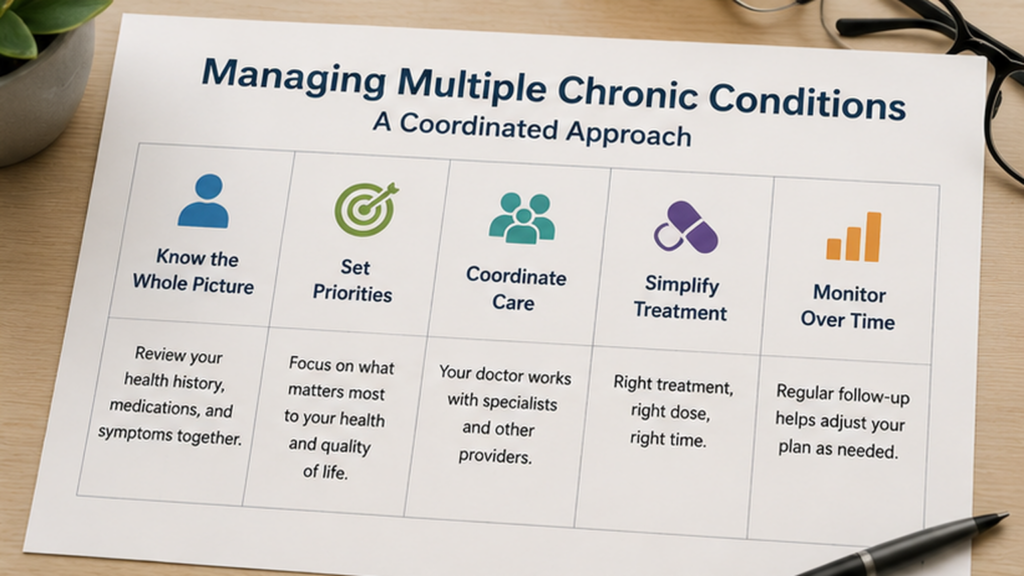
Managing multiple chronic conditions is not simply a matter of following separate plans for each diagnosis. Blood pressure, diabetes, cholesterol, kidney function, respiratory conditions, medications, laboratory results, and new symptoms can influence one another, which is why coordinated care depends on reviewing the complete picture together. A physician who knows your history can help reconcile medications, interpret trends across conditions, coordinate specialist recommendations, and determine which concerns need attention first without treating each diagnosis in isolation.
Blue Point Medical Group’s primary care and internal medicine team works with adults managing multiple ongoing health conditions and can coordinate monitoring, medication review, laboratory testing, and referrals based on individual needs. If you are managing two or more chronic conditions and want a more coordinated approach to your care, Contact Blue Point Medical Group to schedule an appointment with a licensed provider.
This article is for informational purposes only and does not constitute medical advice. Always consult your physician or a qualified healthcare provider for questions about your health or before making changes to your treatment plan.