

The CDC publishes its adult immunization schedule as a grid built for clinical use, with color-coded columns for age bands and footnotes covering every exception. It is accurate, current, and close to unreadable for a patient trying to answer one narrow question, which is whether they personally are behind on anything at thirty-eight, or fifty-seven, or seventy. The information is all there, arranged for someone who already knows the vocabulary. Most adults leave the page no more certain than when they arrived.
This guide reorganizes the same material around age and health history rather than around the vaccine list. What appears below describes the general shape of the adult vaccine schedule by age rather than a personal recommendation for anyone, and your physician makes that determination after reviewing your medical history, your immunization record, and what you have already received.
One caution belongs at the front rather than buried at the end. The schedule is revised at least annually by the CDC’s Advisory Committee on Immunization Practices, and the past two years have brought more change than the decade before them: the pneumococcal age threshold moved, the RSV recommendation expanded to a younger group, and COVID-19 moved out of a universal recommendation entirely. An age or interval that was correct two seasons ago may not be correct now, which is why the durable advice in this article is about how the schedule is organized rather than about any single number in it.
Most Adults Cannot Recall What They Have Already Received
The practical obstacle is rarely disagreement about what is recommended. It is that most adults genuinely do not know what they have had. Childhood records sit in a file at a pediatric practice that may no longer exist, a tetanus booster was given in an urgent care after a cut sometime in the last decade, and a flu shot happened at a pharmacy in a year nobody can pin down. That uncertainty is completely ordinary, and it is the reason so many adults arrive at fifty with no clear sense of where they stand.
Reconstructing the record is usually easier than patients expect. Nevada operates a statewide immunization information system, the registry that participating providers and pharmacies report doses into, and your physician’s office can often look up doses you cannot recall.
Set expectations before you rely on it: registries capture childhood immunizations far more completely than adult ones, since adult doses given at pharmacies, urgent cares, workplaces, and out of state may or may not have been reported. Pharmacy records, prior practice records, and employer or school requirements fill additional gaps. Bringing whatever documentation you do have to an appointment shortens the conversation considerably, and a physician who holds the full picture answers the question faster than any published grid.

The Fall Timing Logic Behind Influenza Vaccination
The CDC recommends influenza vaccination each season for nearly everyone six months and older, and it frames the timing around when antibody protection peaks relative to when the virus circulates. September and October are the months the CDC has generally identified as ideal for most adults, with the caveat that vaccination later in the season still provides benefits as long as influenza is circulating. The reasoning behind that window is worth understanding, because it explains why earlier is not automatically better. Protection is not permanent, and the goal is to have it at full strength during the months that matter locally.
Consider the two failure modes the guidance is designed to avoid. Receiving a flu shot in July may mean waning immunity by February, when influenza activity in Southern Nevada often remains elevated. Waiting until December means moving through the early part of the season without protection at all. That tension is the entire reason practices open flu clinics while the temperature is still above 100 degrees, which strikes many valley residents as absurd until the logic is explained.
Some adults fall outside the standard timing entirely, and one group gets a different product rather than a different date. For adults 65 and older, ACIP preferentially recommends one of three formulations designed to produce a stronger response: high-dose, adjuvanted, or recombinant influenza vaccine. If none of those is available, a standard-dose vaccine is used rather than delayed. Patients who are pregnant follow separate guidance of their own. These distinctions are among the more frequently revised parts of the schedule. Blue Point’s overview of preventive medicine in adult healthcare covers where routine immunization sits within a broader prevention plan.
Where COVID-19 Vaccination Now Sits on the Calendar
COVID-19 vaccination now follows a seasonal pattern closer to influenza than to the original series, with updated formulations released ahead of respiratory virus season. It has also changed more than any other vaccine on the schedule, and the most recent change is structural rather than cosmetic.
For the 2025–2026 season, ACIP moved COVID-19 vaccination from a universal recommendation to shared clinical decision-making, meaning the vaccine is recommended based on an individual conversation between patient and clinician rather than by age alone. The committee framed the risk-benefit calculation as most favorable for adults 65 and older and for people with conditions that raise the risk of severe illness, and least favorable for people without those risks.
That is a meaningful shift in what a patient should expect at the pharmacy counter or the office visit: the question becomes a discussion rather than a default. Because this category has moved repeatedly, anything you read about it, including this, deserves confirmation against current guidance. A physician who follows the annual revisions is a more reliable source than any article that has been sitting online for a season.
For scheduling purposes, the practical consequence is that both vaccines now cluster in the same autumn window. Many practices administer them at a single visit, which reduces trips without changing what either one does. Whether that arrangement suits you depends on your history and preferences, and it is a reasonable question to raise when booking. Patients who prefer to separate them may still do so, generally without any clinical disadvantage.
How the Schedule Changes Across Adult Decades
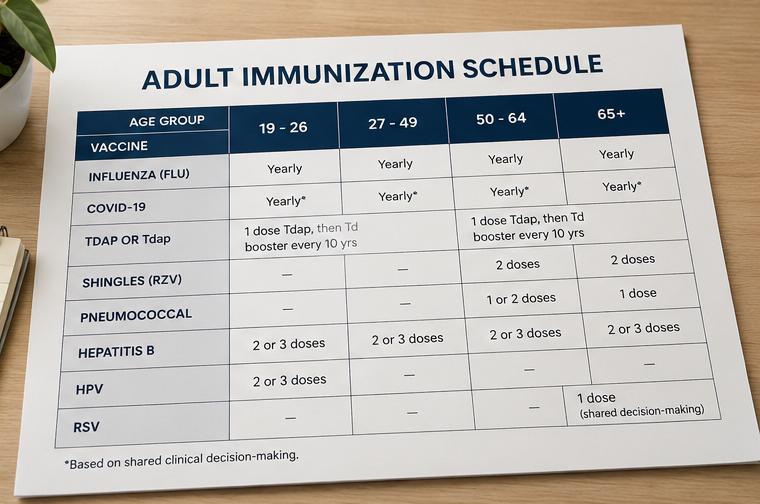
Adult vaccination is not a single list applied uniformly. It shifts in stages, with certain items anchoring the early decades, a distinct cluster appearing around midlife, and a third group converging in later years. The organizing logic is partly age-related immune change and partly the epidemiology of specific illnesses. Reading it decade by decade tends to make the pattern clearer than reading it vaccine by vaccine.
Adults in Their Thirties and Forties
The adult immunization schedule is thinner in these decades than most people expect, which contributes to the uncertainty so many adults carry into their fifties. Tdap, which protects against tetanus, diphtheria, and pertussis, anchors the list. Adults who have never had a dose of Tdap should receive one, and thereafter a booster of either Td or Tdap is recommended every 10 years. Many adults cannot say when their last dose was given, which is the practical reason this item resurfaces at nearly every visit.
Pregnancy changes the picture: Tdap is recommended during every pregnancy, ideally between 27 and 36 weeks, so that maternal antibodies cross to the newborn during the months before the infant can be vaccinated. The recommendation applies to each pregnancy regardless of how recently a previous dose was given.
Two other vaccines reach further into this age band than many adults realize. HPV vaccination is routinely recommended through age 26 for anyone not adequately vaccinated earlier, and from 27 through 45 it becomes a shared clinical decision-making question rather than a routine recommendation, since the benefit depends on prior exposure and individual circumstances.
Hepatitis B has moved toward broad adult coverage in recent revisions rather than remaining purely risk-based, with a universal recommendation for younger adults and risk-based indications above that range. Adults who missed childhood doses of measles, mumps, and rubella or varicella may need catch-up vaccination, where documentation of prior immunity matters considerably more than memory. Blood testing for immunity is sometimes used when records cannot be located, though whether that step is worthwhile depends on the vaccine in question. A guide to health screenings adults need after thirty covers the parallel screening schedule for these years.
The Shift That Begins Around Age Fifty
Most adults notice shingles vaccination first among the changes this decade brings. The recombinant zoster vaccine, sold as Shingrix, is a two-dose series recommended for all adults 50 and older, and separately for adults 19 and older who are immunocompromised. It is recommended regardless of whether you recall having had chickenpox and regardless of whether you received the older live zoster vaccine years ago. Herpes zoster, the clinical name for shingles, arises from the same varicella-zoster virus that causes chickenpox and remains dormant in nerve tissue for decades. Postherpetic neuralgia, the persistent nerve pain that can follow an episode, is the complication driving much of the recommendation, and the CDC is explicit that the second dose completes the series.
Pneumococcal vaccination changed substantially in late 2024, and the change is the single most common reason a patient’s memory of the schedule is now out of date. ACIP lowered the routine age threshold from 65 to 50, recommending a single dose of a pneumococcal conjugate vaccine for adults 50 and older who have not previously received one.
Several conjugate products exist, and which one is used affects whether anything further is needed: a dose of PCV20 or PCV21 generally completes the series, while PCV15 is followed by the older polysaccharide vaccine after a defined interval. Adults with certain chronic conditions are recommended for pneumococcal vaccination well before any age threshold, which is a frequent source of confusion when two patients of the same age receive different advice.
The sequence and spacing between pneumococcal products is one of the more intricate parts of the schedule, and it is worth letting a physician work through rather than reconstructing it yourself. Blue Point’s guide to screenings physicians recommend after forty sits alongside this shift, and what a routine primary care checkup includes explains where the immunization review fits into a visit.
Adults Sixty-Five and Older
Three vaccines converge in this age group. Influenza vaccination continues each fall, often with a formulation the CDC recommends preferentially for older adults, and pneumococcal vaccination applies to essentially everyone in this band who has not completed a series. RSV vaccination joined the adult schedule relatively recently, which is why many patients encounter it for the first time at a visit. Respiratory syncytial virus causes a respiratory illness most people associate with infants, though it produces a meaningful hospitalization burden among older adults.
The adult recommendation has expanded twice since it first appeared. A single dose is recommended for all adults 75 and older, and for adults 50 through 74 who have conditions placing them at increased risk of severe RSV disease; the 50-to-59 group was added in April 2025 using the same risk criteria already applied to adults 60 to 74. RSV vaccination is currently a single dose rather than an annual one, which surprises patients who assume it follows the influenza pattern.
Immunosenescence, the gradual decline in immune response accompanying age, explains why several vaccines change formulation rather than simply continuing unchanged. Higher antigen doses and adjuvants, which are ingredients included to boost the immune response, appear more often in products designed for this group.
Timing also matters more here than at any earlier stage, and scheduling fall vaccinations together at one appointment rather than across three separate trips is generally possible. The CDC’s standing position is that most vaccines may be coadministered at the same visit, using separate injection sites, and that doing so should not be deferred simply because more than one is due. Adults managing several diagnoses at once often have the most to sort through, and managing multiple conditions in primary care covers how a single physician coordinates that work.
Vaccines Tied to Health History Rather Than a Birthday
Age drives part of the schedule, and risk factors drive the rest. This is where the CDC grid becomes dense with footnotes, and where two adults of identical age receive genuinely different recommendations. Adults with diabetes, chronic heart disease, chronic lung disease, chronic kidney disease, liver disease, or an immunocompromising condition are recommended for certain vaccines years before an age-based threshold would apply.
Pneumococcal vaccination is the clearest example, since those conditions have carried an indication regardless of age for many years, and diabetes has long been an indication for hepatitis B vaccination as well. Immunocompromising conditions move the shingles recommendation down to age 19. That is not an inconsistency in the guidance; it reflects how the underlying risk actually distributes.
Several less obvious factors appear on the same list. Smoking functions as an indication for certain vaccines independent of any diagnosis, which surprises many patients when a physician raises it. So does asplenia, the absence of a functioning spleen, and so do cochlear implants, both carrying specific recommendations. Travel adds an entirely separate layer, since destination-specific vaccines fall outside the routine schedule and often require lead time before departure.
Occupational exposure matters for healthcare workers, laboratory personnel, and people working with animals, and household circumstances matter as well. Living with an infant or with someone who is immunocompromised may change what a physician recommends for you rather than for them, which is a rationale patients rarely anticipate. Mentioning these details during a visit costs nothing and occasionally changes a recommendation. Blue Point’s piece on why many adults delay preventive care covers a related pattern, which is that these conversations tend to wait until something has already gone wrong.
Infusion Therapy and Vaccination Serve Different Purposes
IV nutrient therapy and immune support infusions have become popular across Las Vegas, and patients sometimes ask whether one substitutes for the other. It does not, and the distinction is worth stating plainly because marketing in this category frequently blurs it. Vaccination trains the adaptive immune system to recognize a specific pathogen, producing antibodies and memory cells targeted at that organism. An infusion delivers fluids, vitamins, or minerals, which may support hydration and correct a nutrient deficiency when one is present.
Neither replaces the other, and no infusion produces pathogen-specific immunity. A patient may reasonably choose both for their separate purposes, and many do, though choosing an infusion instead of a recommended vaccine trades one thing for something that does not do the same job.
Blue Point offers IV wellness therapy alongside primary care for the purposes it genuinely serves, and a companion piece covers what infusion therapy does and does not do for immune support. A separate guide addresses nutrition and preventive care in more general terms.

Frequently Asked Questions
Can I Get the Flu and COVID Vaccines at the Same Appointment?
The CDC’s general position is that influenza and COVID-19 vaccines may be given at the same visit, at separate injection sites, and many practices do exactly that. Studies of coadministration have reported somewhat more short-term reactogenicity, meaning arm soreness, fatigue, or aches, than either vaccine alone, without a signal of greater serious risk. Some people report more arm soreness or fatigue after receiving two at once. Your physician can tell you whether a single visit fits your situation.
If I Missed a Dose, Do I Have to Start the Series Over?
For most adult vaccines, an interrupted series resumes where it left off rather than restarting, and this is a general principle in CDC guidance rather than a courtesy applied case by case. Someone who received the first Shingrix dose two years ago needs the second dose, not a new pair. Minimum intervals between doses still apply. Bringing whatever record you have lets your physician confirm where you actually stand.
Why Would My Neighbor and I Receive Different Recommendations at the Same Age?
Age sets part of the schedule, and health history sets the rest. Conditions such as diabetes, chronic lung disease, kidney disease, or an immunocompromising condition may move a recommendation years earlier than a birthday would. Smoking, occupation, travel, and who lives in your household may also change what a physician suggests.
Conclusion
Adult vaccination follows both age and health history, which is why two people of the same age may be due for different vaccines. Reviewing your immunization record, chronic conditions, medications, occupation, travel plans, and prior doses with a physician can help clarify whether influenza, shingles, pneumococcal, RSV, COVID-19, or another vaccine may be appropriate this season. Recommendations change over time, so current guidance and your individual medical history matter more than a schedule remembered from several years ago.
Blue Point Medical Group’s primary care team can review your adult immunization history as part of preventive care and help determine which vaccines and timing may apply to you. If you are unsure what you have already received or what may be due this fall, Contact Blue Point Medical Group to schedule a preventive visit with a licensed provider.
This article is for informational purposes only and does not constitute medical advice. Immunization recommendations change annually and vary by age, health history, pregnancy status, and risk factors, and nothing here should be used to decide which vaccines you need. Consult your physician or a qualified healthcare provider, and confirm current recommendations with the CDC.